Written By:- Sachin Sansanwal
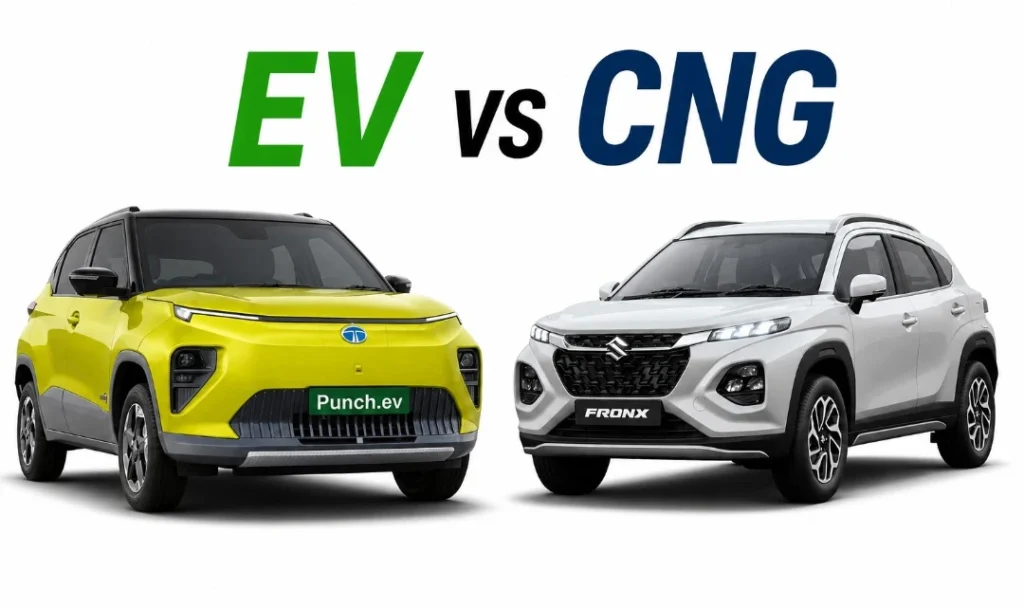
Buying a car is a big decision for any middle-class family in India. In 2026, the biggest confusion is not about brand or model — it is about fuel type. Should you go for an electric vehicle (EV) or stick with a CNG car?
Petrol and diesel prices are already high, and people want something affordable in the long run. EVs look modern and future-ready, but are they really practical for a middle-class family? On the other hand, CNG cars are cheaper to run, but they also come with their own limitations.
In this detailed guide, we will break everything down — no technical jargon, no confusion. By the end, you will clearly understand whether an EV or CNG car is right for you in 2026.
Why EV Cars Are Becoming Popular in India
Electric cars are no longer just a luxury concept. Brands like Tata Motors and MG Motor have made EVs more accessible for middle-class buyers.
People are getting attracted to EVs because:
- Petrol and diesel prices keep rising
- Government is promoting EV adoption
- Running cost is very low
- EVs feel modern and silent
But popularity does not always mean practicality — especially for a middle-class household.
Advantages of Buying an EV Car in 2026
1. Extremely Low Running Cost
This is the biggest reason people consider EVs.
- EV cost per km: ₹1–₹1.5
- Petrol cost per km: ₹7–₹10
- CNG cost per km: ₹3–₹5
If you drive daily (office, school, errands), EV can save thousands every month.
Example:
If you drive 1,000 km/month:
- Petrol: ₹8,000 approx
- CNG: ₹3,500 approx
- EV: ₹1,200 approx
This is a huge difference for middle-class families.
2. Very Low Maintenance Cost
EVs have fewer moving parts compared to petrol or CNG cars.
- No engine oil
- No clutch issues
- Less wear and tear
That means fewer service visits and lower maintenance bills.
3. Smooth and Silent Driving Experience
EV cars feel premium even in budget segment.
- No engine noise
- Instant pickup
- Smooth acceleration
Even entry-level EVs like Tata Tiago EV give a very comfortable driving feel.
4. Government Subsidies and Benefits
Many state governments offer benefits like:
- Subsidy on EV purchase
- Road tax exemption
- Lower registration cost
This reduces the initial cost slightly.
5. Future-Proof Technology
India is slowly moving towards electric mobility. Buying an EV today means you are prepared for the future.
Disadvantages of EV Cars (Very Important)
Now let’s talk about the real problems — because this is where middle-class buyers should be careful.
1. High Initial Cost
Even in 2026, EVs are still expensive compared to petrol or CNG cars.
- Entry-level EV: ₹8–10 lakh
- Same petrol/CNG car: ₹6–8 lakh
This ₹2–3 lakh difference matters a lot for middle-class families.
2. Charging Infrastructure is Still Limited
In big cities, charging stations are growing. But in small towns or villages:
- Charging points are still limited
- Long trips can be stressful
- Planning is required
If you live in a semi-urban area, this can be a serious problem.
3. Charging Time is Long
Unlike petrol or CNG, EVs take time to charge:
- Normal charging: 6–8 hours
- Fast charging: 1–2 hours
This can be inconvenient during emergencies.
4. Battery Replacement Cost is High
EV batteries are expensive.
- Battery replacement cost: ₹2–5 lakh
Even though batteries last long (6–8 years), this is still a big concern.
5. Range Anxiety
Most budget EVs offer:
- 200–350 km range
If you drive long distances frequently, this can be stressful.
Advantages of CNG Cars in 2026
CNG cars are still very popular among middle-class families — and for good reason.
1. Affordable Running Cost
CNG is cheaper than petrol and still economical.
- Cost per km: ₹3–₹5
Not as cheap as EV, but still budget-friendly.
2. Lower Initial Cost
CNG cars are cheaper than EVs.
Example:
- Maruti Suzuki WagonR CNG
- Tata Punch CNG
These cars are affordable for middle-class buyers.
3. Easy Refueling
- CNG filling takes 5–10 minutes
- No waiting like EV charging
This is very convenient.
4. No Range Anxiety
CNG cars come with petrol backup.
So even if CNG finishes, you can switch to petrol.
5. Good Availability
CNG stations are widely available in cities and growing in towns.
Disadvantages of CNG Cars
1. Boot Space Problem
CNG cylinder takes up most of the boot space.
- Less luggage space
- Not ideal for long family trips
2. Slight Power Loss
CNG cars feel less powerful compared to petrol.
- Slower acceleration
- Not ideal for highways
3. Long Queues at CNG Pumps
In some cities:
- Long waiting lines
- Time-consuming refueling
4. Maintenance Slightly Higher Than EV
CNG still has engine-related maintenance.
EV vs CNG: Direct Comparison (2026)
| Factor | EV Car | CNG Car |
|---|---|---|
| Initial Cost | High | Medium |
| Running Cost | Very Low | Low |
| Maintenance | Very Low | Medium |
| Range | Limited | Flexible |
| Refueling Time | Long | Fast |
| Boot Space | Good | Less |
| Long Trip Suitability | Limited | Better |
Ideal Budget for Middle-Class Family (2026)
Let’s talk practical numbers.
EV Budget
- Minimum practical EV budget: ₹9–12 lakh
- Best value range: ₹10–15 lakh
Examples:
- Tata Tiago EV
- Tata Punch EV
CNG Budget
- Ideal budget: ₹6–9 lakh
Examples:
- Maruti Suzuki WagonR CNG
- Tata Punch CNG
Who Should Buy an EV in 2026?
EV is a good choice if:
- You drive daily (office commute)
- Your daily running is 30–80 km
- You have home charging setup
- You live in a city with charging stations
- Budget is ₹10 lakh+
For city users, EV is a smart long-term investment.
Who Should Buy a CNG Car?
CNG is better if:
- Budget is limited
- You travel long distances often
- You don’t have charging facility
- You live in small towns
- You want a hassle-free experience
- CNG is still the safest choice for most middle-class families.
Real Truth: EV or CNG for Middle-Class in 2026?
Let’s be honest.
EV is the future — but in 2026, it is not perfect for everyone.
Choose EV if:
- You want low running cost
- You mainly drive in city
- You can afford higher upfront cost
Choose CNG if:
- Budget is tight
- You need flexibility
- You travel frequently
Final Verdict:-
- For city use + higher budget → EV is better
- For budget + practicality → CNG is smarter
For most middle-class families in India, CNG still makes more sense in 2026.
But if your usage fits EV conditions, it can save a lot of money in the long run.