Written By:- Sachin Sansanwal
Planning to buy Kia Sonet 2026 but confused between HTK and HTK+? Compare price, features, safety, mileage, ownership cost, resale value and real-world practicality in this honest, in-depth buyer’s guide before booking.
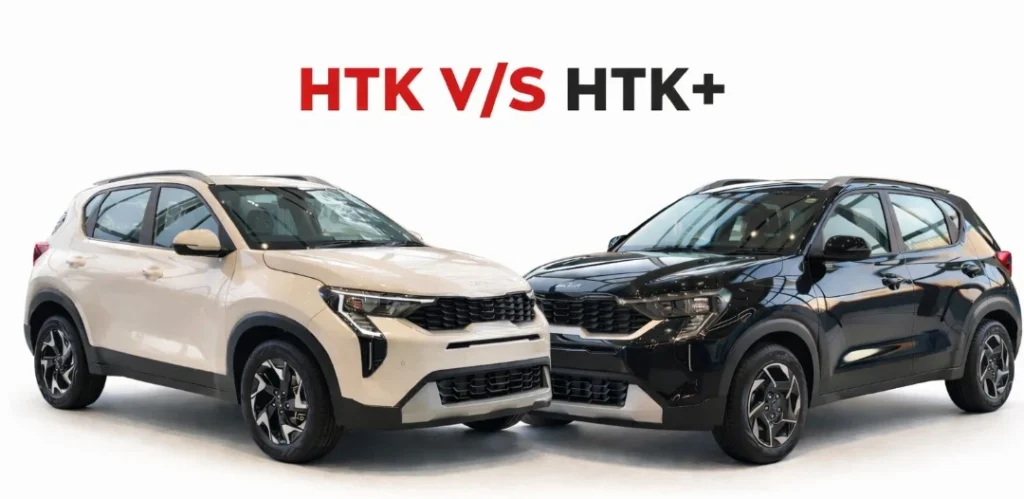
Kia Sonet HTK vs HTK+ 2026 – Honest Detailed Comparison Before You Book
Buying a car in India is never just about the car.
It’s about EMI stress.
It’s about family comfort.
It’s about resale value.
And it’s about whether you will regret not stretching your budget a little more.
If you are considering the 2026 Kia Sonet and are confused between HTK and HTK+, you are standing at one of the most common decision points.
Both variants sit in the heart of the Sonet lineup.
Both look premium.
Both offer strong engine options.
But one costs more. And that extra money needs justification.
In this detailed review, we will compare everything practically — not just brochure specs.
We will cover:
- Latest 2026 pricing structure
- Engine and performance
- Exterior differences
- Interior and comfort
- Infotainment & connectivity
- Safety package
- Real-world mileage
- Long-term ownership cost
- Insurance and maintenance impact
- Resale value comparison
- Daily usage practicality
- Pros and cons
- Final verdict table
- Detailed FAQs
Let’s break this down like a real buyer.
Kia Sonet 2026 – Why It’s Still One of India’s Most Popular Compact SUVs
The 2026 Kia Sonet continues to dominate the compact SUV segment because it balances:
- Aggressive styling
- Feature-loaded cabin
- Multiple engine options
- Diesel availability
- Urban-friendly size
It appeals to:
- Young professionals
- Small families
- First-time SUV buyers
- Upgrade buyers from hatchbacks
But the confusion begins when choosing the right variant.
HTK is positioned as a strong mid-level value trim.
HTK+ adds comfort and tech upgrades.
Now let’s go deep.
Price Difference – Is the Extra Money Logical?
On average, HTK+ costs around ₹70,000 to ₹1,00,000 more than HTK depending on engine choice and city.
This difference may look small on paper.
But on-road with insurance and RTO, the difference can touch ₹85,000–₹1.2 lakh.
Now the real question:
Will you feel that difference daily while driving?
Let’s find out.
Engine & Performance – No Difference Here
Both HTK and HTK+ offer similar engine options:
1. 1.2L Naturally Aspirated Petrol
Smooth for city
Low maintenance
Ideal for daily office commute
2. 1.0L Turbo Petrol
More power
Better highway confidence
Fun to drive
3. 1.5L Diesel (where available)
Excellent mileage
Best for long distance and high usage
Important point:
There is absolutely no engine difference between HTK and HTK+ if you select the same powertrain.
Performance, pickup, torque — everything remains identical.
So engine cannot be your deciding factor.
Exterior Comparison – Small Details Matter
At first glance, both variants look almost identical.
Same bold grille.
Same SUV stance.
Same sharp headlamp design.
But subtle differences exist.
HTK may come with:
- Steel wheels with covers
- Basic antenna
- No rear wiper (variant dependent)
HTK+ often includes:
- Alloy wheels
- Rear wiper and washer
- Shark fin antenna
- Slightly more premium detailing
Now ask yourself:
Do you care about alloys and rear wiper?
For city-only usage, maybe not critical.
For highway and monsoon driving, rear wiper becomes useful.
Interior Experience – This Is Where Difference Becomes Clear
Inside the cabin, the difference starts becoming noticeable.
HTK Interior Feel
- Functional layout
- Smaller infotainment screen
- Fabric seats
- Manual AC
- Steering mounted controls
It feels practical and decent.
But not exciting.
HTK+ Interior Feel
- Larger touchscreen display
- Rear parking camera
- Possibly auto climate control (engine dependent)
- More polished interface
- Slightly enhanced cabin appeal
For a family buyer, HTK+ feels more complete.
In 2026, reverse camera is almost a necessity — especially for new drivers.
Infotainment & Tech – Daily Usage Impact
Technology affects everyday driving experience.
HTK:
- Basic infotainment
- Android Auto & Apple CarPlay (wired)
- No reverse camera in most cases
HTK+:
- Bigger display
- Reverse camera with guidelines
- Better UI feel
Parking in tight city spaces without camera can feel stressful.
HTK+ reduces that stress.
Safety Features – Core Structure Same
Both variants usually offer:
- 6 airbags (as per latest updates)
- ABS with EBD
- ESC
- Hill start assist
- Rear parking sensors
Structural safety remains same because body platform is same.
HTK+ advantage: Reverse camera support adds safety convenience.
Real-World Mileage – Practical Numbers
Let’s talk practical numbers, not brochure claims.
1.2 Petrol: 16–18 km/l city
1.0 Turbo: 16–17 km/l
Diesel: 19–22 km/l
Variant does not affect mileage.
Driving style does.
Maintenance & Service Cost
Kia’s service cost is reasonable in compact SUV segment.
Annual service: ₹5,000–₹8,000 approx (petrol)
Diesel slightly higher.
HTK+ does not increase service cost significantly.
Insurance cost may be marginally higher because of higher vehicle value.
Long-Term Ownership – 5 Year Perspective
This is where smart buyers think differently.
Imagine:
You save ₹80,000 today by buying HTK.
After 5 years:
- Buyer may prefer HTK+ in resale market
- Reverse camera becomes expected feature
- Bigger infotainment adds resale appeal
HTK+ may recover some extra cost during resale.
So HTK+ makes more long-term sense for some buyers.
Daily Usage Scenario Comparison
Scenario 1: Office Commute Buyer
City driving, limited parking space
Reverse camera helps
HTK+ wins
Scenario 2: Budget Controlled Buyer
Strict EMI limit
Wants SUV feel
HTK works fine
Scenario 3: Family User
Kids + luggage + highway trips
Better comfort matters
HTK+ feels better
Pros & Cons – Clear Breakdown
Kia Sonet HTK Pros
Lower upfront cost
Same engine performance
Good safety package
Premium SUV look
HTK Cons
No reverse camera
Smaller screen
Slightly less premium feel
Kia Sonet HTK+ Pros
Reverse camera
Bigger infotainment
Better resale demand
Feels more complete
HTK+ Cons
Higher price
Still not top variant luxury
Final Comparison Table:-
Category | HTK | HTK+
Price Advantage | Yes | No
Engine Options | Same | Same
Infotainment | Basic | Bigger Screen
Reverse Camera | No | Yes
Exterior Premium Feel | Average | Better
Resale Appeal | Good | Better
Best For | Budget buyers | Feature-focused buyers
Which Variant Should You Buy in 2026?
If your budget is tight and you want the Sonet experience without stretching finances, HTK is a sensible and practical choice.
But if you can stretch slightly and plan to keep the car for 5–7 years, HTK+ makes more logical sense.
Because in 2026:
Reverse camera and bigger infotainment are no longer luxury — they are daily-use essentials.
Personally, for balanced ownership and better future value, HTK+ feels more complete.
Frequently Asked Questions (FAQ)
Is there any engine difference between HTK and HTK+?
No. Engine and performance remain identical.
Is HTK good enough for city driving?
Yes, absolutely.
Does HTK+ justify extra ₹80,000?
For comfort and resale, yes.
Which variant has better resale value?
HTK+ slightly better.
Is reverse camera really important?
In Indian city parking conditions — yes.
Which is best variant for long term ownership?
HTK+ is more future-ready.
Final Conclusion:-
Choosing between Kia Sonet HTK and HTK+ 2026 is not about power.
It is about practicality.
HTK saves money today.
HTK+ saves regret tomorrow.
If budget is manageable, HTK+ gives a more satisfying ownership experience.
But if you want controlled spending without missing core SUV experience, HTK remains a smart buy.
The best decision is the one that matches your lifestyle — not just your budget.